



Why is a fire drill so hard for some children?
A fire drill social story prepares a child for a moment that seems designed to be difficult: a very loud alarm, with no warning, that nobody can turn off, and a sudden change in the school day. Many children cover their ears, freeze or want to run.
The audiology service at Leeds Community Healthcare (NHS) explains that it is very common for children to dislike loud sounds, especially when they are sudden or new. KidsHealth (Nemours) adds that being tired or stressed makes sound sensitivity worse, and a busy school hallway is rarely a calm place.
Fire drill autism support: why preparation matters
Noise sensitivity is more common in autistic children, and the NHS lists reacting very strongly, or not at all, to sounds among the possible signs of autism in children. The National Autistic Society describes how, with sound hypersensitivity, noises can seem much louder and unexpected sounds can be especially distressing. A loud alarm at school is not a small thing for these children, and their reaction is not a tantrum. A social story turns the unknown into a sequence they can predict: the alarm rings, we line up, we walk out, we come back.
How to read this social story with your child
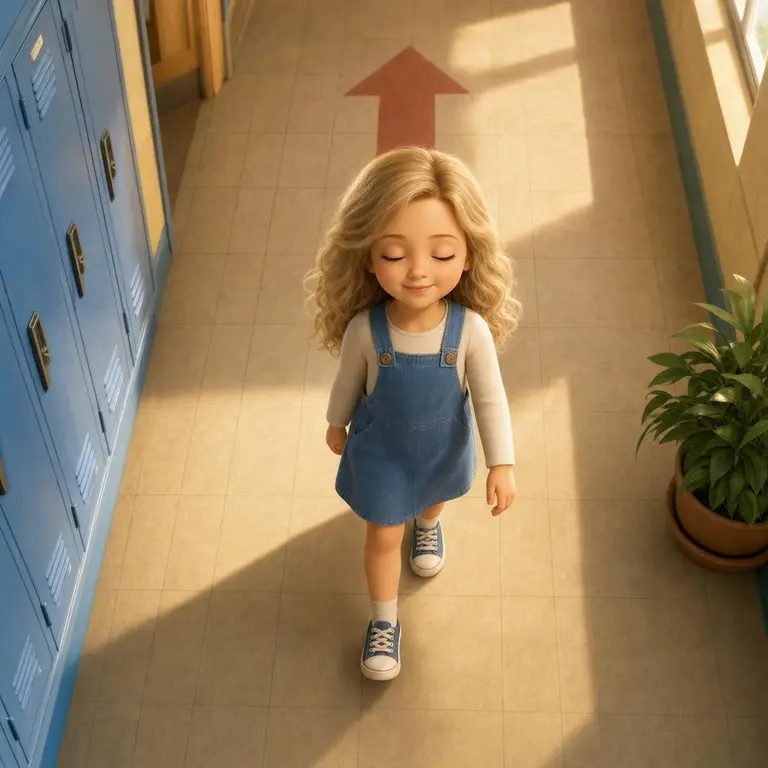
In the story, Lola is in a bright school hallway when the fire alarm starts to ring. Her heart beats fast and she wants to run away, but the noise feels too loud. Her mom puts a gentle hand on her shoulder and tells her it is okay to feel scared.
- Read it at a calm time, well before the drill. At home, at bedtime, on a quiet weekend. Never during or right after an alarm.
- Pause on Lola's feelings. Fast heart, wanting to run. Ask, "What does your body do when something is really loud?" Make it clear that being scared is allowed.
- Learn Lola's line together: "I count to three and take one step." Count "one, two, three" out loud and take one step across the room. Then another.
- Notice what the teacher says. Ms. Rivera explains that the line helps everyone move safely. The plan is not to hide or stay put: it is to keep walking with the group.
- Point out the second practice. Later the school holds another drill in the gym. A dog named Bongo is dancing near the door, and Lola uses the same count to step into the gym hallway.
- Talk about the honest ending. When the drill is over, Lola's heart slows down. The fear is still there, but she knows she can stay calm by counting and stepping whenever the alarm sounds again. Feeling scared and coping can happen at the same time.
- Make it your child's school. In the story Lola's mom is with her. At school, it will usually be the teacher, so tell your child who will be next to them and where their class lines up.
What to say and what to avoid
| Try saying | Try to avoid |
|---|---|
| "The alarm is very loud. It means we practice going outside." | "It's just a noise, don't be silly." |
| "You can feel scared and still walk with your class." | "If you cry, everyone will look at you." |
| "Count to three and take one step, like Lola." | Long explanations while the alarm is ringing. |
| "Your teacher will be right there with you." | Promising "there won't be any alarm today." |
| "You walked out with your class. That was brave." | Talking about real fires in scary detail. |
Preparing for the loud alarm at school
- Walk the route. If the school allows it, visit the classroom and walk the path to the meeting point on a quiet day. Knowing where the door leads helps.
- Give your child control of the sound. Leeds Community Healthcare recommends noisy toys, music or videos of loud sounds that your child can start and stop. Play a recording of an alarm quietly, let your child turn it up and down, and practice Lola's count while it plays.
- Play "fire drill" at home. One person is the teacher, the others line up and walk to the front door counting steps. Turn the practice into a game.
- Use ear defenders wisely. For a short, very loud event they can help, but KidsHealth and Leeds Community Healthcare both warn that using them all the time may make a child more sensitive. Keep them where the teacher can hand them over quickly.
- Plan the moment after. A drink of water, a quiet corner or a favorite object back in class helps your child's body settle once it is over.
If your child struggles with loud sounds at home too, our social story for loud noises covers the blender, the vacuum and fireworks. For more school moments, see our guide to social stories for preschool and kindergarten.
Using this fire drill story in the classroom or in therapy
Teachers can read the story to the whole class in the days before a planned drill, practice lining up and walking to the door while counting "one, two, three, step", and use the same words when the real alarm rings. A child who knows the script is more likely to keep moving with the group. Sharing the story with families means children hear the same plan at home and at school.
Occupational therapists and other specialists can use it as part of a sensory plan for a child who finds the alarm very hard. You can read more about how NeuroStories supports schools and therapists on our page for professionals.
When to talk to a professional
Talk to your pediatrician if the fear does not improve after a few months, if loud sounds seem to cause pain, or if your child becomes very distressed about going to school because of the alarm. They can check your child's hearing and refer you to an audiologist if needed. If your child is autistic, plan fire drills together with their care team and the school.
When does a personalized story help even more?
Every school sounds and looks different. With NeuroStories you can create an "A challenge" story about your child's own fire drill, with your child as the hero and their family as cartoons, using the words their teacher uses and the calm plan that works for them. The narration is calm, and the "Voice only" sound setting keeps extra sounds out while you prepare. Seeing themselves walk out with their class makes the next alarm feel more predictable. It is the idea behind social stories: preview what will happen and show, step by step, how to handle it.